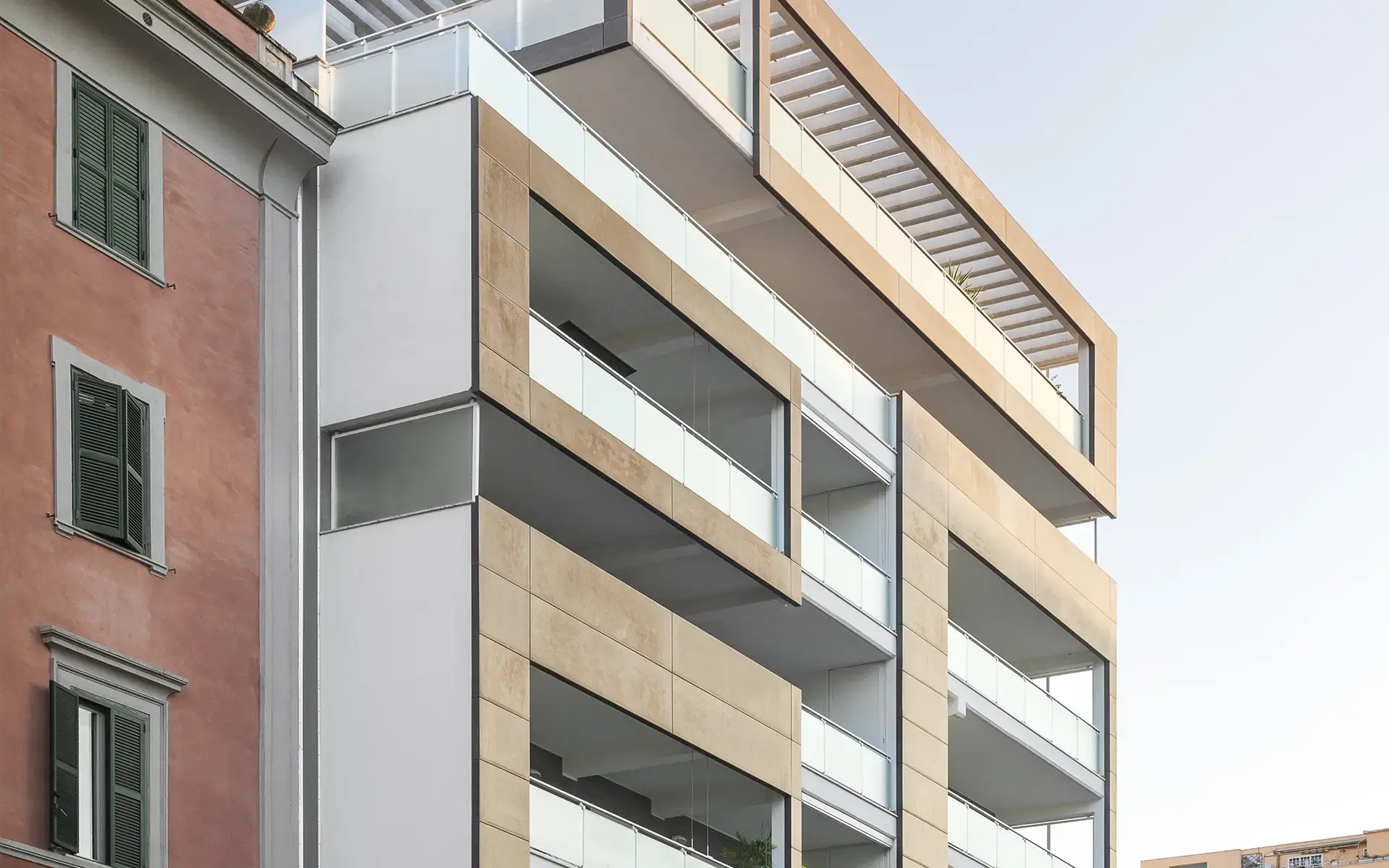
Regeneration meets urban dynamism
CAM Group's intervention on Former Filanda will allow the reuse of a dilapidated building, located in a central area of Rome, overlooking the monumental complex of the Aurelian Walls between the Basilica of Saint John Lateran and the Basilica of the Holy Cross in Jerusalem. An action that will return to the city a structure with a view to the future between urban bioeconomy and hybrid spaces with a view to a project capable of combining environmental and social needs with spaces for sharing and using urban transport. An initiative to respond to the challenges of climate change starting from the enhancement of urban contexts with a view to decarbonization, sustainability and resilience.


A rebirth from the ashes
The redevelopment action ofFormer Filanda in Viale Castrense it covers an area of about 1400 square meters, in an area that is at the center of an urban regeneration project following the construction of the new Line C stations of the “Pigneto” and “San Giovanni” metro, a center-suburb connection that is part of the revitalization and re-functionalization of urban spaces. The structure will come back to life from a state of neglect in which it was located, even after the three fires of 2015 that had further damaged it. CAM Group's intervention, worth 6 million euros, is linked to the international call for C40I Reinventing Cities won by the company and which involves the introduction of collective functions and activities open to the public such as co-working, event spaces, co-living and food.

A prestigious treasure chest for companies
CamGroup, a dealership and lender, has built a team that includes the designers and tenants who will occupy the redeveloped areas to make them productive. The purposes of destination of the property, as per the announcement, concern very specific types: from students to tourist accommodation to coworking, passing through spaces dedicated to crafts and all the services of collective housing. Among the leading tenants are DoveVivo, the European platform for managing the residential world, and Excellence, a consolidated reality that works in the enhancement of food and wine excellence.


A pact between identity and future
From a design point of view, a series of aspects have been privileged, intended to make the Former Filanda a virtuous model to replicate: from the bioeconomy that involves the use of land as a capacity to activate innovative urban cycles, such as urban agriculture activities intended to produce food within the city, to the management of hybrid spaces that allow us to maintain, thanks to a recovery intervention, the facades of pre-existence, as fragments of historical identity, and a new volume to bring together past and current times. Furthermore, the redevelopment will allow a better use of the Carlo Felice Park through the reopening of the passage connecting the Aurelian Walls, thanks to a design that promotes safe pedestrian flow, facilitated by the construction of a signposted pavement with low travel speed.
Browse The gallery