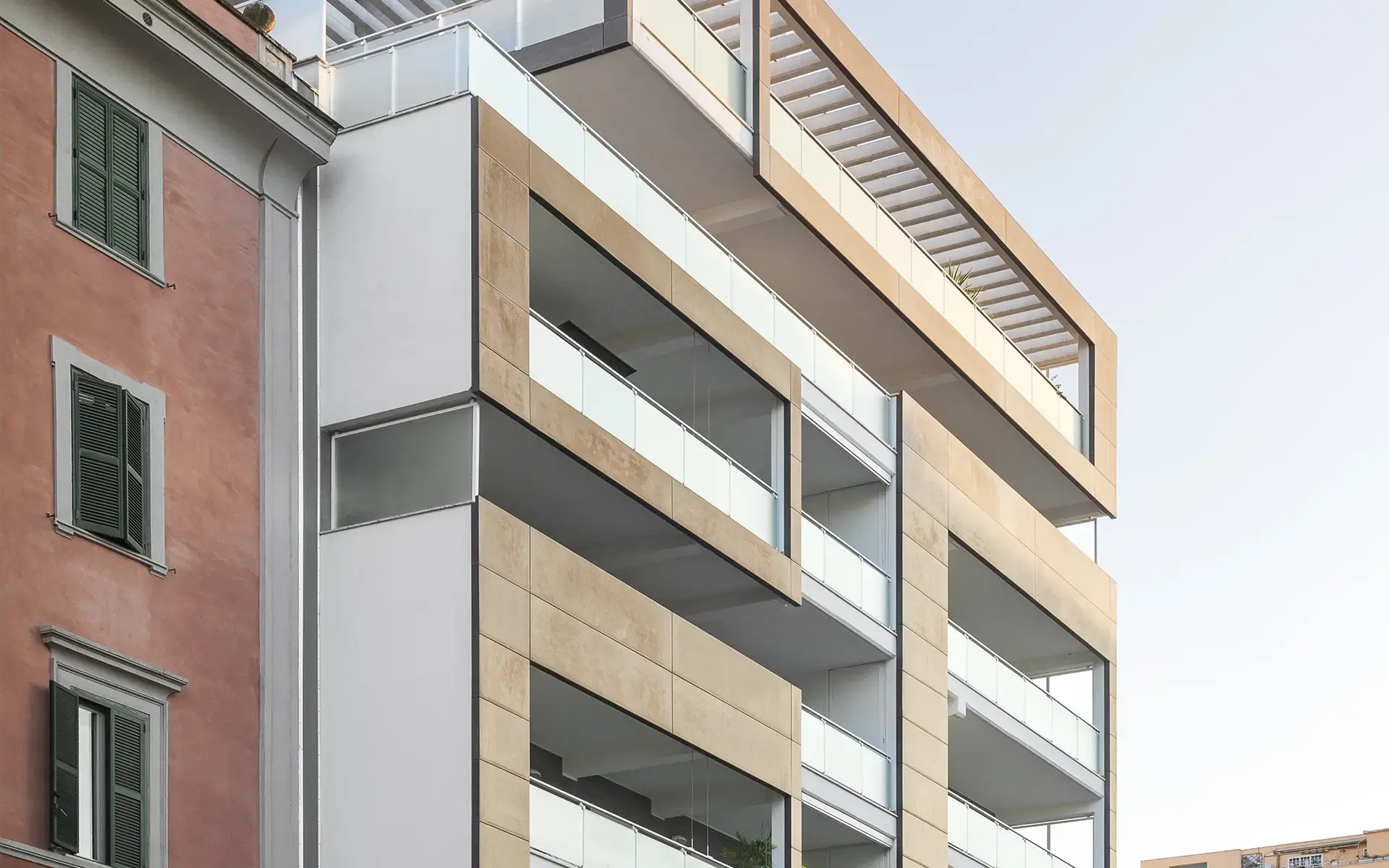
A futuristic work that dialogues with urban space
The Roma Tre Rectorate is an architectural project that innovates the city thanks to the high-performance formula of the public-private partnership that has allowed an investment of about 60 million euros. As part of the wider program of urban redevelopment of the 'Ostiense-Marconi-Garbatella' area, the building has become a reference model for the coordinates of the capital's architectural future, framed as an intervention that anticipates a new important redevelopment process which expands the action of urban regeneration from the center to the suburbs.


A functional beauty
The Rectorate was born from an idea of CAM S.p.a. and MAC S.r.l., specialized in urban redevelopment interventions on the territory, who in 2017 proposed to the administration of the Roma Tre University the construction of a new headquarters that could respond, with a futuristic aesthetic, all energy and environmental challengesof modernity. After winning the tender for a financial project, the two companies start the construction of a structure at the forefront of design and development. The Rectorate is a work of 12,000 square meters between classroom and office surfaces and about 13,000 square meters underground intended for parking and technical rooms, designed to accommodate the passage of 33 thousand students and 300 administrative employees, awarded with the DNA Paris Award. Due to the beauty of the structures and the functionality of the spaces, the new complex is considered one of the most sustainable buildings built in Rome in recent decades.

Transparency is synonymous with urban integration
The futuristic work dialogues with urban space through three elliptical buildings that wind vertically, profoundly changing the skyline of two districts of Rome that have hosted university courses for over thirty years. Large areas and transparent windows, which overlook the public square, connect the interior spaces of the architectural complex with the external spaces of everyday city life in a continuous dialogue, restoring the impact of a majestic and solid structure perfectly embedded in the urban context. The building was developed according to the principles of passive design and environmental sustainability to minimize energy demand for the operation and for the needs of the building, optimizing comfort levels in indoor and outdoor areas.


The future now
The new Rectorate, which also houses a hanging garden, is developed as a contemporary university campus and is located along the ancient Via Ostiense, combining, as is the tradition of CAM Group, tradition and innovation. From a plant engineering point of view, the complex uses photovoltaic panels and heat pumps in the contemporary spirit of buildings with high energy efficiency.
Browse The gallery